What Is a Remittance Address? A Clear Payment Guide
A remittance address is the designated location where a payer sends payment and related financial documents to ensure the funds reach the right recipient. This specialized address differs from a company’s general mailing or billing address. It routes money directly to a payment processing center, lockbox, or financial department rather than a front office. Understanding the remittance address meaning prevents delayed payments, rejected transfers, and cash flow problems for both individuals and businesses. For international transactions, pairing this address with SWIFT/BIC codes adds the routing precision that global banking systems require.
What is a remittance address and how does it work?
A remittance address is explicitly designated for receiving payments, and it looks like a regular mailing address but serves a very different purpose. Invoices label it clearly with “Remit to:” to reduce confusion for the payer. The address points to a specific location, such as a bank lockbox, a payment processing center, or an accounts receivable department, rather than a company’s headquarters or general office.
The core function is separation. By keeping payment correspondence away from general business mail, companies reduce the risk of checks getting lost, misrouted, or delayed. A freelancer might list a P.O. box as the remit address while operating from a home office. A corporation might direct all payments to a regional processing center hundreds of miles from its main campus.

For electronic payments, the remittance address may be a digital portal, an email address tied to a payment platform, or a set of banking credentials. The format changes depending on the payment method, but the purpose stays the same: get the money to the right place, processed by the right people, without delay.
How does a remittance address differ from a billing or mailing address?
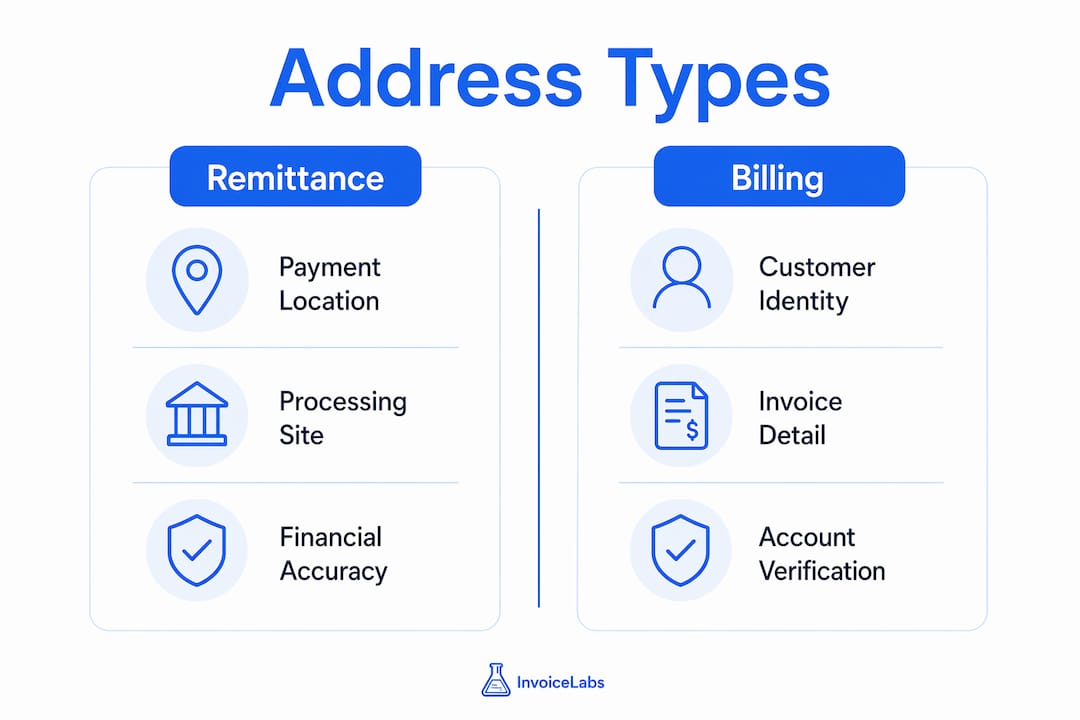
Three address types appear on most invoices and financial documents, and each one serves a distinct function.
- Remittance address: Where you send payment. This is the “Remit to:” field on an invoice. It routes funds to a payment processing center or lockbox.
- Billing address: The address tied to your payment method, such as the address on file with your credit card issuer. It verifies your identity during a transaction.
- Mailing address: The general address for correspondence, packages, and non-payment documents. It often matches a company’s headquarters or operational office.
The remittance address is distinct from the billing or mailing address specifically to prevent payments from mixing with general correspondence. A vendor’s billing address might be in Chicago, but the remit address might direct checks to a lockbox in Dallas managed by their bank. Sending a check to the wrong address can delay payment application by days or even weeks.
The confusion between these three address types causes more payment problems than most people realize. Accounts payable teams regularly receive checks at general office addresses that should have gone to a lockbox, forcing manual rerouting and slowing down reconciliation.
Pro Tip: Before sending any payment, call or email the vendor to confirm the current remittance address. Addresses change when companies switch banks or restructure their accounts receivable operations, and an outdated address on a saved invoice can send your payment to the wrong location.
What information typically accompanies a remittance address?
A remittance address alone does not complete a payment instruction. The supporting details vary based on whether the payment is domestic or international.
For a domestic check payment, the remittance address is often sufficient. You write the check, include any invoice reference numbers, and mail it to the “Remit to:” address. The bank or lockbox handles the rest.
Electronic and international payments require significantly more detail. Insufficient payment instructions cause payments to be delayed or rejected by intermediary banks. The table below summarizes what each payment type typically requires.
| Payment detail | Domestic payment | International payment |
|---|---|---|
| Remittance address | Required | Required |
| Account number | Required for ACH | Required |
| Routing number | Required for ACH | Not applicable |
| SWIFT/BIC code | Not required | Required (8–11 characters) |
| IBAN | Not required | Required in many countries |
| Correspondent bank details | Rarely needed | Sometimes required |
| Invoice or reference number | Recommended | Recommended |
SWIFT and BIC codes are 8–11 characters long and tell the global banking network which financial institution holds the recipient’s account. Without them, an international wire transfer cannot reach its destination. The remittance address tells you where to send payment; the SWIFT/BIC tells the banking system how to get it there.
Pro Tip: For international payments, ask your recipient for a complete payment instruction sheet that includes the remittance address, SWIFT/BIC code, IBAN, and any correspondent bank details. One document with all the information eliminates back-and-forth and prevents costly wire rejections.
Why do businesses use separate remittance addresses?
Businesses use dedicated remit addresses for three concrete reasons: compliance, security, and operational efficiency. Each reason carries real financial consequences if ignored.
- Compliance: Regulatory frameworks require businesses to maintain clear audit trails for incoming payments. A dedicated remittance address creates a controlled entry point that is easier to monitor and document.
- Security: Payments directed to verified locations such as bank lockboxes minimize processing errors and unauthorized access. A lockbox sits inside a bank’s secure facility, reducing exposure to check fraud and theft.
- Error reduction: When all payments flow through one designated address, accounts receivable teams can match payments to invoices faster and with fewer mistakes.
- Fraud prevention: Efficient address tracking and validation systems improve payment processing and reduce the risk of fraud. A single, verified remittance address is harder to spoof than a general office address.
Large organizations often maintain multiple remittance addresses, each tied to a specific business unit, region, or payment type. A manufacturing company might have one lockbox address for domestic wholesale customers and a separate electronic payment portal for international distributors. This separation keeps cash flow organized and makes reconciliation far less complicated.
The risk of mixing addresses is not theoretical. Payments sent to a general company address can sit unopened for days, get filed with non-financial correspondence, or require manual intervention to process. Each delay costs time and can damage the relationship between payer and payee.
Pro Tip: Update your remittance address in every active invoice template, payment portal, and vendor record whenever your banking arrangements change. A single outdated record can redirect payments for months before anyone catches the error.
How to find and use a remittance address for your payments
Finding the correct remit address takes less than a minute when you know where to look. Using it correctly takes one additional step: verification.
- Check the invoice first. The “Remit to:” field on an invoice is the primary source. It appears near the payment terms section, often at the bottom of the document. This field holds the address the vendor has designated for payment receipt.
- Review billing statements and payment portals. Recurring vendors often list remittance details on monthly statements or inside their online payment portal. Log in to the portal and look for a “Payment instructions” or “How to pay” section.
- Contact the vendor directly. If no address appears on the invoice or statement, call or email the accounts receivable department. Ask specifically for the current remittance address and any required reference numbers.
- Distinguish between physical and electronic payment instructions. Remittance addresses may be physical locations or digital portals depending on the payment method. A check payment needs a physical mailing address. An ACH or wire transfer needs banking credentials. Confirm which format applies before sending.
- Verify before every new payment. Payments sent to wrong or general addresses cause processing delays and impact cash flow. Treat the remittance address as something to confirm, not assume, especially if you have not paid this vendor recently.
The Invoicelabs invoice blog covers practical topics like this one, including how to structure invoice fields so your own clients always know exactly where to send payment. Clear invoice design reduces the number of “where do I send this?” calls you receive.
Key Takeaways
A remittance address is the single most important address on any invoice because it determines whether your payment arrives, gets processed, and gets applied to the right account.
| Point | Details |
|---|---|
| Remittance address definition | It is the designated address for receiving payments, labeled “Remit to:” on invoices. |
| Different from billing address | The billing address verifies identity; the remittance address routes the actual payment. |
| International payments need more | SWIFT/BIC codes (8–11 characters) and IBAN numbers must accompany the remittance address for global transfers. |
| Dedicated addresses reduce errors | Bank lockboxes and payment centers minimize fraud, lost checks, and reconciliation delays. |
| Always verify before paying | Confirm the current remittance address directly with the vendor before sending any payment. |
The detail most people overlook until it costs them
Working with invoices and payment workflows over the years, I have seen one pattern repeat itself constantly: people treat the remittance address as a formality rather than a critical piece of payment infrastructure. They copy an address from an old invoice, assume it is still valid, and send a check or wire. Then they wait. And wait.
The uncomfortable truth is that a wrong remittance address does not always generate an immediate error. A check mailed to a company’s general office might sit in a mailroom for two weeks before anyone realizes it needs to go to the lockbox. A wire sent without the correct SWIFT code might bounce back after three business days, minus intermediary bank fees. Neither outcome is obvious until the payment is already late.
My recommendation is simple: treat the remittance address the same way you treat a bank account number. Confirm it directly with the recipient before the first payment, and re-confirm it any time you receive a new invoice with updated details. The two minutes that takes will save you from the hours of follow-up that a misdirected payment creates.
The shift toward electronic payments has made this slightly more complex, not simpler. A vendor might accept checks at one address, ACH payments through a portal, and wire transfers to a different bank account entirely. Knowing which instruction set applies to your payment method is now part of getting it right.
— Black Flame Digital
Get your invoices paid faster with Invoicelabs
Clear remittance instructions on your invoices are the fastest way to reduce payment delays. Invoicelabs builds those instructions directly into every invoice you create.
The free invoice generator from Invoicelabs lets you create a professional invoice in under 30 seconds, with dedicated fields for your remittance address, payment terms, and banking details. Real-time tax calculations and instant delivery via Stripe mean your clients receive a complete, accurate payment instruction set the moment you hit send. Invoicelabs also tracks invoice status so you know exactly when a payment is in motion. No hidden fees, no guesswork about whether your remittance details reached the right person.
FAQ
What is the purpose of a remittance address?
A remittance address directs payments to a specific processing location, such as a bank lockbox or accounts receivable center, so funds are received, recorded, and applied to the correct account without delay.
Is a remittance address the same as a billing address?
No. A billing address verifies a payer’s identity with their financial institution. A remittance address is where the actual payment is sent and processed, and the two are often different locations entirely.
Where do I find a remittance address on an invoice?
Look for the “Remit to:” field, which typically appears near the payment terms section at the bottom of the invoice. If it is not listed, contact the vendor’s accounts receivable department directly.
Do I need more than a remittance address for international payments?
Yes. International wire transfers require a SWIFT or BIC code (8–11 characters), an IBAN in most countries, and sometimes correspondent bank details. The remittance address alone is not sufficient to route a cross-border payment.
Can a remittance address be electronic?
Yes. For electronic payments, the remittance address may be a payment portal URL, an email address linked to a payment platform, or a set of ACH or wire transfer credentials rather than a physical mailing address.
Recommended
Send your next invoice in seconds
Create professional invoices, track payments and get paid faster — free to start.