UK 4 Step Escalation Ladder When a Client Refuses to Pay an Invoice
Check that the invoice is correct and the payment terms have actually expired, then send one short, polite reminder with the payment link attached. Call the client directly, ask for a promised payment date, and confirm that date in writing. If the deadline you agree passes with no payment or explanation, move straight to the escalation ladder rather than sending a second friendly nudge.
TL;DR:
- Ensure the invoice is sent to the correct recipient with all necessary details before initiating any follow-up steps.
- Follow a fixed escalation process starting with gentle reminders, phone calls, written notices, and finally a formal letter before legal action.
- Incorporate statutory interest and recovery fees into a final warning letter if the invoice remains unpaid after the escalation steps.
- Collect comprehensive documentation, including contracts, proof of delivery, and communications, to support any legal claim.
- Prevent late payments by setting clear terms, taking deposits, offering multiple payment methods, and automating reminders.
Table of Contents
- Client refuses to pay invoice: verify, resend, and chase politely
- Escalation ladder: rungs, timing, and short scripts to use
- Letter before action, statutory interest, and small-claims options
- Debt collection and mediation: when to use each and expected costs
- Documentation checklist: what to gather to support a claim
- Prevention: contract language, deposits, and automated reminders
- What I’d do in the first 30 days
- Get paid faster with Invoicelabs
- Where to go for official help
- Sources
Client refuses to pay invoice: verify, resend, and chase politely
Before you assume bad faith, rule out a paperwork problem. A huge share of late payments trace back to a missing PO number, a wrong email address, or an invoice that landed in someone’s spam folder rather than deliberate refusal.
Start here:
- Confirm the invoice went to the right person, not just the right inbox, and that it includes the PO number, VAT details, and correct amount.
- Resend the invoice as a clean PDF with a working payment link, not a forwarded thread buried under old replies.
- Try a second channel. If email got no response in three or four business days, call. Phones cut through excuses that email lets people ignore.
- Send a short written follow-up after any phone call, even a one-line email: “Confirming our call, you’ll send payment by Friday.”
That last step matters more than it looks. Finance professionals note that most unpaid invoices come from cash-flow squeezes or process failures rather than deliberate refusal, so a calm, solution-focused tone usually gets money moving faster than a demand does. Keep the reminder polite. You’re not accusing anyone yet. You’re closing a gap that a distracted accounts team probably didn’t mean to leave open.
Escalation ladder: rungs, timing, and short scripts to use
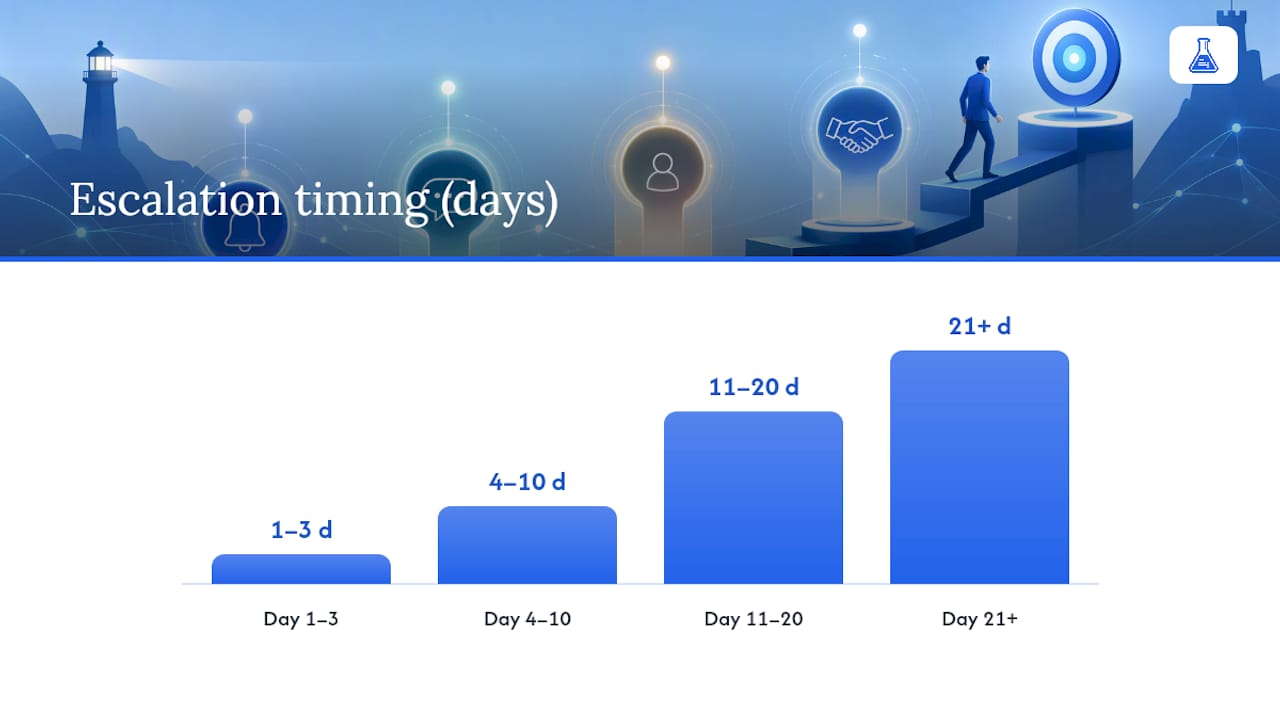
If polite reminders go nowhere, work through fixed stages instead of repeating the same email with more exclamation points. Each rung has a job: nudge, confirm, escalate, document.
- Day 1 to 3 after due date: friendly nudge. Subject line: “Quick check on invoice #1042.” Body: “Hi Sam, just flagging invoice #1042 is now a few days overdue. Here’s the link again in case it got buried: [pay link].”
- Day 4 to 10: firm follow-up plus phone call. Subject: “Invoice #1042: still outstanding.” Ask directly for a payment date and get it in writing afterward.
- Day 11 to 20: written notice of intent. State plainly that a formal demand will follow if payment doesn’t arrive by a specific date.
- Day 21+: letter before action. This is the final, formal warning before legal steps.
Adjust the timing to your actual terms. Thirty-day terms suit the schedule above; fourteen-day terms should compress each rung by roughly half. What stays constant is the discipline: never skip a rung, and always follow a call with something in writing. An ordered, documented escalation does two things at once. It keeps the relationship civil, and it builds the dated paper trail you’ll need if this ends up in court.
Pro Tip: Keep every message factual and free of frustration, even on rung three. A calm paper trail reads far better in front of a judge than an angry one, and it keeps the door open for repeat business once this invoice is settled.
Letter before action, statutory interest, and small-claims options
A letter before action is your final written warning, and it needs to read like a formal notice, not an angry email. Include:
- The exact amount owed and the original due date.
- Statutory interest accrued and any fixed recovery fee you’re entitled to add.
- A firm deadline, typically 7 to 14 days, to pay in full.
- A plain statement that you’ll pursue a money claim if the deadline passes.
UK commercial contracts carry statutory rights to claim interest and a fixed recovery fee on late payments, even when your contract never mentions either. That protection exists whether or not you remembered to write it into your terms.
If the letter before action doesn’t land a payment, you can make a money claim through the courts. For amounts under £10,000, the small-claims track is designed for exactly this kind of dispute: no need for a solicitor, court fees scale with the claim size, and most cases resolve in a few months rather than years. File through Money Claim Online, and if the client still doesn’t pay after a judgment, you can pursue a County Court Judgment to enforce it, though enforcement has its own limits and costs.
Debt collection and mediation: when to use each and expected costs
Collections agencies typically work on contingency, taking a percentage of what they recover, or charge a flat fee for smaller debts. That’s worth it for a large invoice you’d otherwise write off, but it eats hard into a modest one.
Mediation costs less and works best when the dispute is about quality or scope rather than a flat refusal to pay. A neutral third party can often unlock a stalled conversation in a single session.
Before escalating to either:
- Tell the client plainly what happens next if payment doesn’t arrive, so nothing feels sprung on them.
- Weigh the relationship. Sending a client to collections usually ends the account for good.
- Remember that collections activity can affect a client’s credit profile, which is leverage, but also a one-way door.
Documentation checklist: what to gather to support a claim
Courts and collections partners both want the same thing: a clean, dated record that proves the debt is real and undisputed. Gather these before you escalate any further.
- The original invoice and any revised versions.
- The signed contract or statement of work outlining scope and price.
- Proof of delivery, such as signed timesheets, shipping confirmations, or a client sign-off email.
- The purchase order, if one exists.
- Every written confirmation from calls or meetings.
- Remittance advice for any partial payments already received.
Organize everything chronologically, as PDFs, in one labeled folder. A payment discrepancy audit approach works well here, tracing each invoice line back to its source document.
Pro Tip: If a client offers a partial payment while you sort out a dispute, take it. Partial cash in the bank beats a clean principle and an empty account, and it doesn’t weaken your claim on the remaining balance.
Prevention: contract language, deposits, and automated reminders
Most collection headaches start at the contract stage, not the invoice stage. Fix the terms and you fix a lot of what comes after.
- Write a clear due date, a stated late interest rate, and recovery costs directly into your payment terms, so nothing depends on statutory defaults alone.
- Take a deposit of 25% to 50% upfront on larger jobs, and bill in stages rather than waiting for one lump sum at the end.
- Offer more than one payment method. A client who finds bank transfer annoying might pay a card link instantly.
- Automate your reminders so a follow-up goes out the moment an invoice ages, without you having to remember. Tools built for appointment scheduling show the same principle: reducing friction earlier in the process cuts the amount of chasing you do later.
What I’d do in the first 30 days
Day one: verify the invoice and terms. Day two: resend with a payment link and call the client. Day three: put the promised date in writing. If that date slips, start the escalation ladder immediately rather than waiting to see if they remember on their own. Stay factual, never personal. The relationships worth keeping usually survive a firm, well-documented chase.
— Black Flame Digital
Get paid faster with Invoicelabs
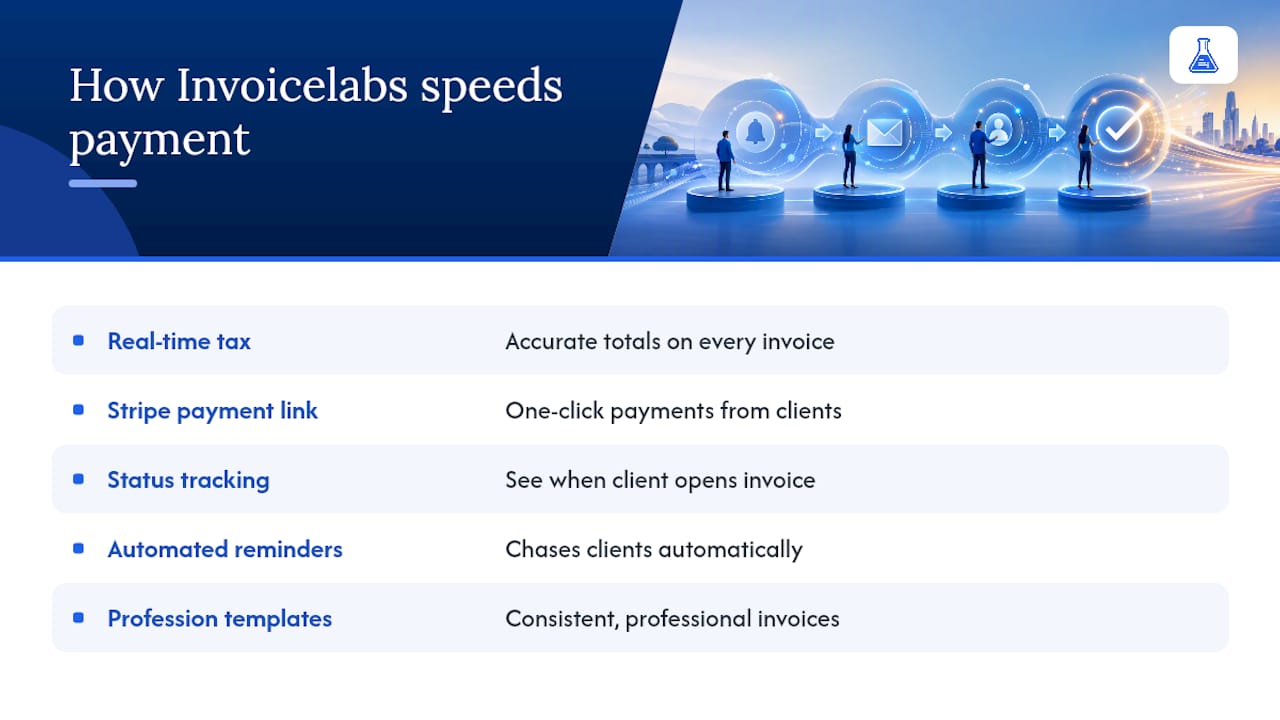
Invoicelabs is the faster alternative to chasing invoices by hand. Every invoice goes out with real-time tax calculations, a working Stripe payment link, and status tracking, so you know the moment a client opens it instead of guessing whether it landed in a spam folder.
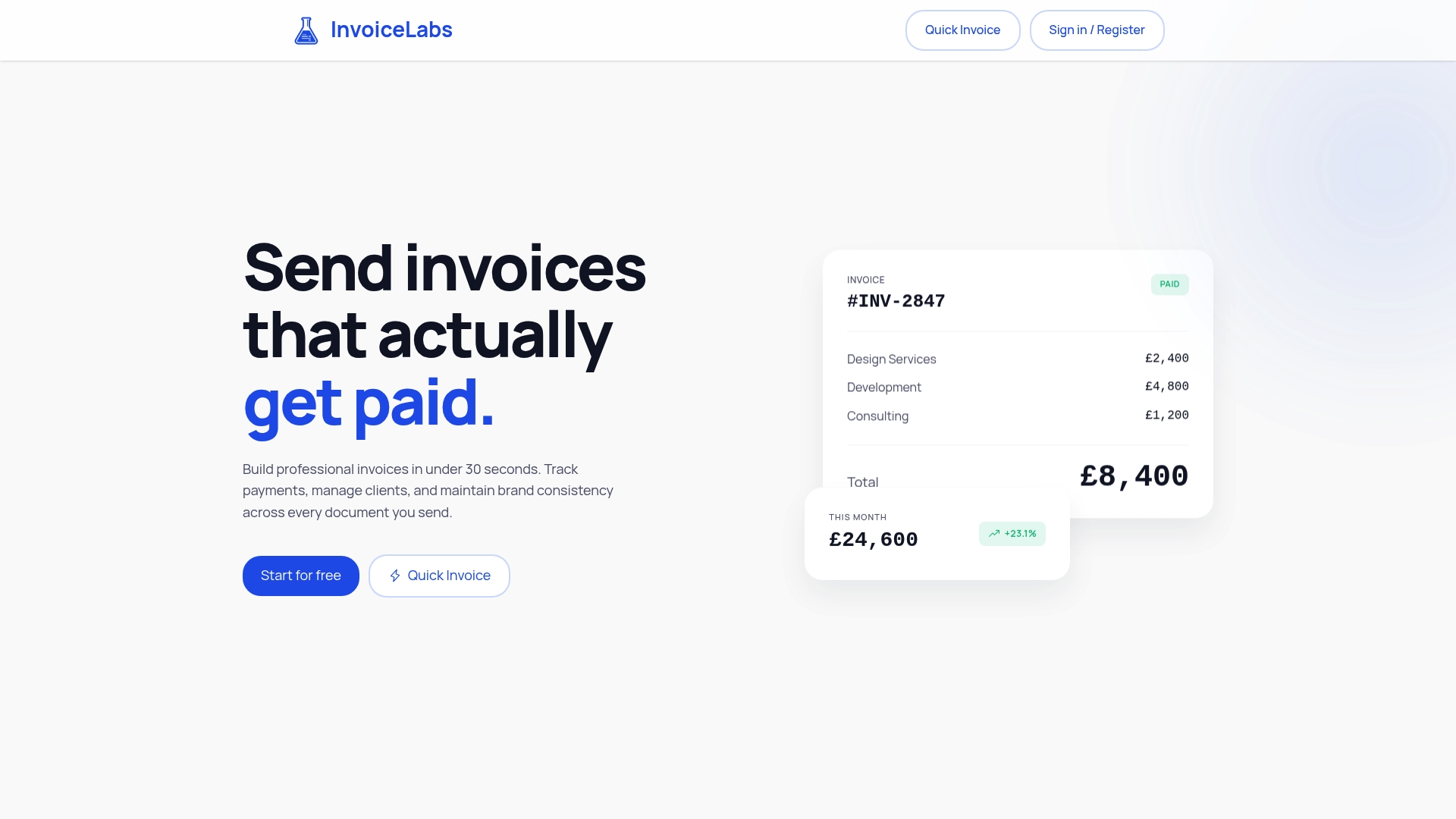
That visibility alone closes most of the gap between “sent” and “paid,” because half the fight with late invoices is not knowing where things stand. Automated reminders chase clients on your behalf, so a slipping due date doesn’t depend on you remembering to follow up. Profession-specific templates, from consultants to graphic designers, keep every invoice looking professional and consistent, which matters more than people admit when a client is deciding whether to take your payment terms seriously.
Try the free invoice generator on your next job and send a professional, trackable invoice in under 30 seconds.
Where to go for official help
For the legal and procedural side, go straight to the source. GOV.UK covers late payment interest and debt recovery rules and the money claim process. The Small Business Commissioner offers free, practical guidance and templates for chasing unpaid invoices.
This article is general information, not a substitute for advice from a qualified financial advisor. Consult a qualified financial professional about your own circumstances before acting on anything here.
Sources
- Gov
- Help with unpaid invoices - Small Business Commissioner
- Moneyclaim
- How to handle unpaid invoices - Stripe Resources
Recommended
Send your next invoice in seconds
Create professional invoices, track payments and get paid faster — free to start.