Payment Discrepancy Meaning: Audit & Fix Guide for Finance Teams
A payment discrepancy is a mismatch between an expected payment amount or record and what was actually received, posted, or paid. Two distinct categories exist: payroll or pay-equity discrepancies, where one employee or group receives less compensation than comparable peers, and transactional discrepancies, where an invoice, settlement, or bank deposit does not match the originating record. Your first move is to scope the problem: is this a single transaction, a batch of settlements, or a population-wide payroll audit? That answer determines everything that follows.
Table of Contents
- What does “payment discrepancy” actually cover?
- What causes payment discrepancies?
- Concrete examples of payment discrepancies you will recognize
- How to identify and measure payment discrepancies
- How to resolve a payment discrepancy
- How to prevent payment discrepancies from recurring
- How invoicing tools reduce reconciliation friction
- Key Takeaways
- The cost of treating every discrepancy the same way
- Fewer invoice discrepancies start with a cleaner invoice
- Useful sources for U.S. practitioners
What does “payment discrepancy” actually cover?
The term shows up in at least three distinct operational contexts, and conflating them wastes investigation time. Here is where finance teams most commonly encounter them:
-
Payroll and compensation. An employee’s actual pay does not match their offer letter, salary band, or what a comparable colleague earns. The discrepancy may stem from a data-entry error in the HRIS, a misclassification, or a structural pay gap across demographic groups. Pay-equity discrepancies are conceptually different from transactional errors and may require statistical analysis and compliance review rather than a simple journal entry correction.
-
Accounts payable and invoice vs. PO. A vendor invoice arrives for an amount, but the approved purchase order was for a lower amount at a different unit price. The difference sits unresolved in the AP queue until someone runs a three-way match. This is one of the most common sources of invoice friction in mid-size businesses.
-
Payment gateway and merchant settlement. Your gateway processed gross sales on Tuesday, but the bank deposit on Thursday shows a lower amount. The gap is processor fees, a chargeback reserve, and a refund deducted before the net payout hit your account. Without separate ledger lines for gross sales, fees, and net deposits, every settlement will look like a discrepancy.
-
Bank and ACH transfers. A wire or ACH payment clears for the right amount but carries a mismatched reference number, so the AR team cannot match it to the open invoice. The payment exists; the match does not.
Each context has a different owner, a different data source, and a different resolution path. Knowing which one you are in before you start investigating cuts resolution time significantly.
What causes payment discrepancies?
Most discrepancies trace back to one of six root causes. The table below maps each cause to its detection clue and the typical corrective action.

| Cause | Detection clue | Corrective action |
|---|---|---|
| Timing and settlement lag | Bank deposit date differs from processing date by 1–5 days | Apply a date-tolerance window (±3 business days) before flagging it as an exception |
| Fee netting by processor | Gross sales exceed bank deposit by fee amount | Post separate ledger lines for gross revenue, processor fees, and net deposit |
| Technical or integration error | Duplicate transactions or missing records in settlement file | Reconcile at batch/payout ID level, then drill to individual transactions |
| Human data-entry error | Invoice amount, PO quantity, or payroll rate entered incorrectly | Three-way match (PO, goods receipt, invoice) before payment release |
| Refunds and chargebacks | Deposit lower than expected with no matching credit memo | Pull chargeback and refund detail from processor report; create offsetting entries |
| Misclassification or commission error | Pay rate or job code does not match role; commission base differs from contract | Audit role classification and commission calculation rules against source contracts |
When does a variance signal a pay-equity audit instead of a transactional fix? If the same unexplained shortfall appears consistently across a demographic group after controlling for role, tenure, and performance, the issue is structural, not clerical. That scenario calls for a regression-based statistical analysis and likely involves HR, legal, and compliance, not just the AP team.
Concrete examples of payment discrepancies you will recognize
Naming the discrepancy type before you start investigating is not just good practice. It preserves evidence in the right format and routes the issue to the right person faster.
Why naming the type matters: A chargeback deducted from a settlement and a salary mismatch between two engineers both qualify as payment discrepancies, but they require completely different evidence, different stakeholders, and different remediation timelines. Calling them both “a payment issue” delays resolution and can cause you to collect the wrong documentation.
1. Payroll salary mismatch between peers. Two software engineers at the same level, hired the same year, show a significant annual salary gap with no documented performance or scope difference. The immediate triage step: pull the original offer letters, current HRIS records, and any salary-band documentation for that level. If the gap persists after controlling for legitimate factors, escalate to HR and legal.
2. PO vs. invoice quantity or price mismatch. A vendor ships units at one price each, but the invoice bills at a higher unit price. The difference sits in AP. Triage: pull the signed PO and the goods receipt note, confirm the contracted unit price, and contact the vendor for a corrected invoice or credit memo before releasing payment.
3. Merchant settlement vs. gross sales (fee netting). Your point-of-sale system shows sales for the week. The processor deposits a lower amount. The gap is the processor’s fee, deducted before the payout. Triage: download the processor’s itemized settlement report and verify that fees, refunds, and adjustments account for the full difference. If they do, the accounting fix is reclassification, not a dispute.
4. Refund or chargeback deducted after the fact. A customer disputes a charge some time after the original sale. The processor deducts it from next week’s settlement with no separate notification. Triage: cross-reference the settlement file against your refund and chargeback log and create a matching credit memo in the ledger.
5. ACH or wire with a mismatched reference. A client sends a payment via ACH but enters their internal PO number in the reference field instead of your invoice number. The payment clears the bank but sits unmatched in AR. Triage: check the remittance advice email, match by amount and date, then update the payment record with the correct invoice reference before closing the transaction.
How to identify and measure payment discrepancies
A repeatable audit workflow matters more than a one-time fix. Run these steps in order.
-
Download the source reports. Pull the processor’s settlement or payout report, your bank statement, and your ledger for the same period. Use the same date range for all three. Do not rely on summary totals; you need line-item detail.
-
Lock the period and collect identifiers. Note the payout ID, settlement ID, and batch ID for every transaction in scope. These identifiers are your matching keys. A practical troubleshooting approach is to reconcile three layers in order: gateway settlement report, bank statement, then ledger entries.
-
Map gross to net. For each payout, verify that gross sales minus fees, refunds, and chargebacks equal the net deposit. Record each component as a separate line. The table format below shows the structure with amounts for gross sales, processor fees, refunds, chargebacks, and net deposit.
-
Run three-way matching for AP invoices. For each invoice in the period, confirm the PO number, the goods receipt note (GRN), and the invoice amount all agree. Three-way matching is a consistent AP control that catches most invoice discrepancies before payment is released.
-
Group payroll populations for pay-equity analysis. If the audit is payroll-focused, group employees by comparable role, level, and tenure. Calculate the mean and median pay for each group. Unexplained gaps above a defined threshold trigger a deeper regression analysis.
-
Classify exceptions. Sort unmatched items into timing differences, fee variances, data errors, or genuine disputes. Timing differences within your tolerance window close automatically on the next reconciliation cycle. Everything else gets a root-cause investigation.
Pro Tip: Track gross sales, processor fees, refunds, and net deposits as four separate ledger lines from day one. Using a date-tolerance window of ±3 business days for settlement matching eliminates the majority of false-positive exceptions before they reach the investigation queue.
How to resolve a payment discrepancy
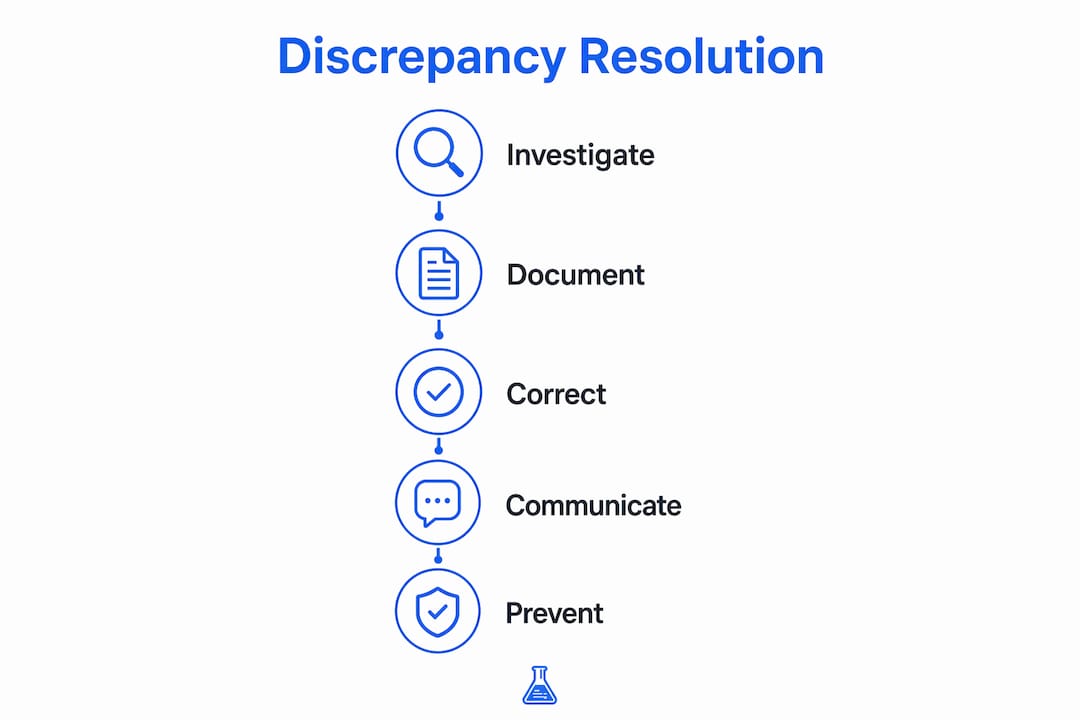
The core remediation sequence is: investigate, document, correct, communicate. Every step after that is an elaboration of one of those four actions.

Investigate. Collect the evidence before contacting anyone. Pull the processor report, the bank statement, the original invoice or PO, and any email or contract that establishes the expected amount. Map each discrepancy to a payout ID or transaction reference. Without that mapping, you cannot tell the processor or vendor exactly what you are disputing.
Document. Create a remediation log with the discrepancy amount, the type (timing, fee, error, chargeback), the evidence collected, and the date discovered. This log is your audit trail if the issue escalates to a dispute or a compliance review. If processor settlement files do not arrive on schedule, escalate before dispute windows close; treating delays as routine can convert recoverable exceptions into write-offs.
Correct. Issue the appropriate accounting entry. For a fee-netting discrepancy, reclassify the difference from revenue to a processor-fee expense account. For an AP invoice mismatch, request a corrected invoice or credit memo from the vendor before posting. For a payroll error, issue a corrected paycheck or adjustment in the next pay cycle and update the HRIS record.
Communicate. Notify the counterparty with the specific transaction reference, the amount in question, and the supporting documentation. For vendor disputes, a written notice with the PO and GRN attached is standard. For employee pay corrections, a written explanation and a timeline for the adjustment builds trust and satisfies documentation requirements.
Timeline and cost factors. A simple fee-netting reclassification takes under an hour once the settlement report is in hand. An AP invoice dispute with a vendor typically resolves within a short timeframe depending on the vendor’s response and whether a credit memo is needed. A payroll correction for a single employee can take multiple pay cycles. A pay-equity investigation involving regression analysis, legal review, and potential back-pay calculations can run for several months and carry significant legal exposure if unresolved gaps are found. Cross-border transactions add currency conversion complexity and can extend timelines further.
Automating settlement-level matching and posting separate journal entries for fees, refunds, and net deposits reduces investigation volume and prevents cash-flow errors that compound over time.
How to prevent payment discrepancies from recurring
Prevention comes down to three layers: policy, process controls, and a regular reconciliation cadence. None of them work alone.
Policy controls (payroll and compensation):
- Establish documented salary bands for every role and level, and enforce them at the offer stage.
- Adopt a salary-history ban in hiring to prevent historical gaps from compounding.
- Require written approval for any pay adjustment outside the band, with a documented business reason.
- Schedule an annual pay-equity review using regression analysis for organizations above a defined headcount threshold.
Process controls (AP and invoicing):
- Enforce three-way matching on every invoice above a defined dollar threshold before payment is released. Clear invoice payment terms on every document reduce the most common source of AP disputes.
- Require a valid PO number on all vendor invoices; reject invoices without one.
- Validate invoice line items against the contracted price list before routing for approval.
- Use prepayment invoices with explicit terms when advance payments are involved, so both parties have a documented record before funds move.
Process controls (payment gateway and settlements):
- Switch to settlement-based accounting: record gross sales, fees, and net deposits as separate lines from the first transaction.
- Map every payout to its payout ID in the ledger. Payout IDs are the most reliable matching key across processor, bank, and ledger.
- Set a date-tolerance window (±3 business days) for settlement matching to suppress timing-difference false positives.
Governance and audit trail:
- Retain payout IDs, settlement files, and bank statements for the full processor dispute window, which varies by processor but is typically 60–120 days.
- Assign a named owner for daily settlement checks and a separate owner for monthly reconciliation sign-off. Shared ownership means no ownership.
- Log every exception, its classification, and its resolution in a running reconciliation register. That register is your evidence if an auditor or regulator asks.
Accounting data backup is part of governance too. Protecting your reconciliation records with a reliable accounting data backup solution means you can reconstruct any period if a system failure or dispute requires it.
How invoicing tools reduce reconciliation friction
Tools reduce repetitive reconciliation work by syncing settlement details, mapping payout IDs to invoice records, and separating fee lines automatically. The manual alternative, exporting CSVs and matching by hand, does not scale once transaction volume grows.
A practical tool-assisted workflow looks like this:
| Step | Action | Output |
|---|---|---|
| 1. Create and send invoice | Generate invoice with line items, tax, and payment terms | Timestamped invoice with unique invoice number |
| 2. Receive payout | Customer pays via card (Stripe) or bank transfer | Payout ID recorded at transaction level |
| 3. Import settlement | Pull processor settlement report | Gross sales, fees, refunds, net deposit per payout |
| 4. Match to bank deposit | Reconcile net deposit against bank statement line | Confirmed or flagged exception |
| 5. Post journal entries | Record gross revenue, fee expense, refund liability, net cash | Clean ledger with no netting distortion |
Invoicelabs fits naturally into steps 1 and 2. The platform generates invoices in under 30 seconds, tracks invoice status in real time, and processes card payments via Stripe, which means the payout ID is tied to a specific invoice from the moment the customer pays. That linkage is exactly what makes steps 3 through 5 faster: instead of hunting for which payment corresponds to which invoice, the reference is already there.
For AP teams managing purchase invoices, consistent invoice formats with clear PO references reduce the matching errors that cause most three-way-match failures. A well-structured purchase invoice with a PO number, line-item detail, and agreed unit prices is the single most effective upstream control.
Pro Tip: Use the payout ID or batch ID as your primary matching key, not the transaction date. Dates shift with settlement timing; payout IDs do not. Building your reconciliation register around payout IDs cuts false positives and makes dispute escalation straightforward.
Key Takeaways
A payment discrepancy is a mismatch between an expected and actual payment record, and resolving it requires separating the type first: payroll/pay-equity issues need statistical analysis and compliance review, while transactional discrepancies need a three-layer reconciliation of gateway, bank, and ledger.
| Point | Details |
|---|---|
| Define the type first | Separate payroll/pay-equity discrepancies from transactional ones before collecting evidence. |
| Three-layer reconciliation | Reconcile gateway settlement, bank statement, and ledger in that order using payout IDs as matching keys. |
| Post gross, fees, and net separately | Recording net deposits only hides fee and refund variances; separate ledger lines eliminate false discrepancies. |
| Escalate before dispute windows close | Unresolved processor exceptions become write-offs once the dispute window (typically 60–120 days) passes. |
| Invoicelabs reduces upstream friction | Invoicelabs ties each Stripe payout to a specific invoice at creation, making settlement matching faster and more accurate. |
The cost of treating every discrepancy the same way
The most expensive mistake in payment reconciliation is not missing a discrepancy. It is applying the wrong remediation to the right problem.
A fee-netting difference is not a billing error. A timing lag is not a failed payment. A salary gap between two engineers is not a payroll glitch. Each of those requires a different owner, different evidence, and a different resolution path. When teams route all three to the same generic “payment issue” queue, the fee difference gets disputed with the processor (wasting relationship capital), the timing lag triggers an unnecessary vendor call, and the salary gap sits unresolved long enough to become a compliance liability.
The practical fix is a triage rule before any investigation starts: classify the discrepancy by type, assign it to the correct owner, and set a resolution deadline based on complexity. A fee reclassification should close the same day. An AP dispute should have a vendor response deadline of five business days. A pay-equity finding should have a legal review scheduled within two weeks of discovery. Without those deadlines, investigations drift, and drifting investigations cost more than the original discrepancy.
One more thing worth saying plainly: most gateway discrepancies are not errors at all. They are expected variances from fee netting, timing, and refunds. Changing your accounting to track gross sales, fees, and net deposits as separate lines removes the majority of false positives before they ever reach the investigation queue. That single accounting change is worth more than any reconciliation tool you can buy.
Fewer invoice discrepancies start with a cleaner invoice
When a discrepancy traces back to an unclear invoice, the fix is upstream, not in the reconciliation spreadsheet. Invoicelabs gives freelancers, consultants, and small business owners a faster way to issue invoices that are accurate from the start: real-time tax calculations, Stripe card payment integration, and invoice status tracking that shows exactly when a client has viewed and paid.
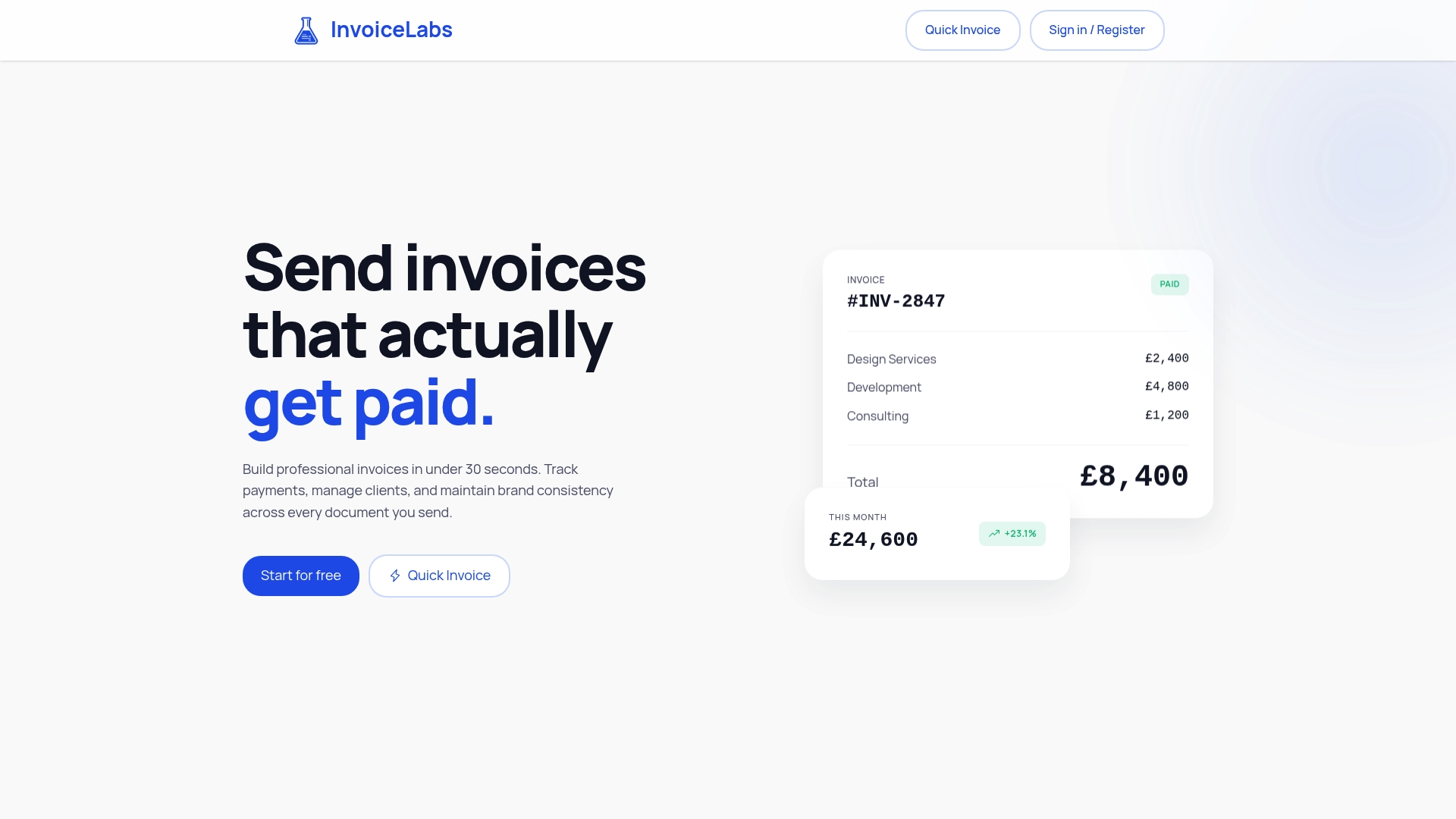
The workflow is direct. Create an invoice in under 30 seconds, send it instantly, collect payment via Stripe, and track the payout ID back to the original invoice record. That linkage is what makes reconciliation straightforward rather than a manual matching exercise. No hidden fees, no complicated setup, and no chasing down which payment belongs to which client.
If you are dealing with invoice-related discrepancies and want a cleaner starting point, create your first invoice free with Invoicelabs, or explore the full platform at invoicelabs.io.
Useful sources for U.S. practitioners
- EEOC Pay Data and Guidance — The primary federal source for pay-equity compliance requirements; consult when a payroll discrepancy investigation reveals potential discrimination.
- DOL Wage and Hour Division — Governs minimum wage, overtime, and recordkeeping requirements; relevant when a payroll discrepancy involves potential FLSA violations.
- IRS Payroll Tax Guidance — Authoritative source for payroll tax withholding rules; use when a pay discrepancy involves incorrect tax calculations or withholding errors.
- Payments & Risk — Reconciliation — Practical reconciliation framework covering three-way matching and settlement-based accounting; useful for AP and gateway reconciliation workflows.
- ReconcileOS — Settlement Troubleshooting Guide — Step-by-step guide to reconciling gateway, bank, and ledger layers; consult when a settlement discrepancy cannot be explained by fees or timing alone.
- Webgility — Payment Gateway Settlement Discrepancies — Explains fee netting and how to restructure ledger entries to eliminate false discrepancies; useful for ecommerce and multi-channel merchants.
- Pew Research — Gender Pay Gap in the U.S. — Data on structural pay gaps; useful context when a payroll audit surfaces unexplained differences across demographic groups.
- Equal Rights Advocates — Pay Gap Data — Census Bureau-sourced pay gap analysis; relevant for organizations conducting pay-equity audits and benchmarking against national data.
Recommended
Send your next invoice in seconds
Create professional invoices, track payments and get paid faster — free to start.