Invoice Payment Terms Examples for Freelancers and SMBs
What are the most common invoice payment terms examples?
The most widely used invoice payment terms in US business practice fall into a handful of clear categories. Knowing the right phrasing for each one keeps your invoices unambiguous and your clients on schedule.
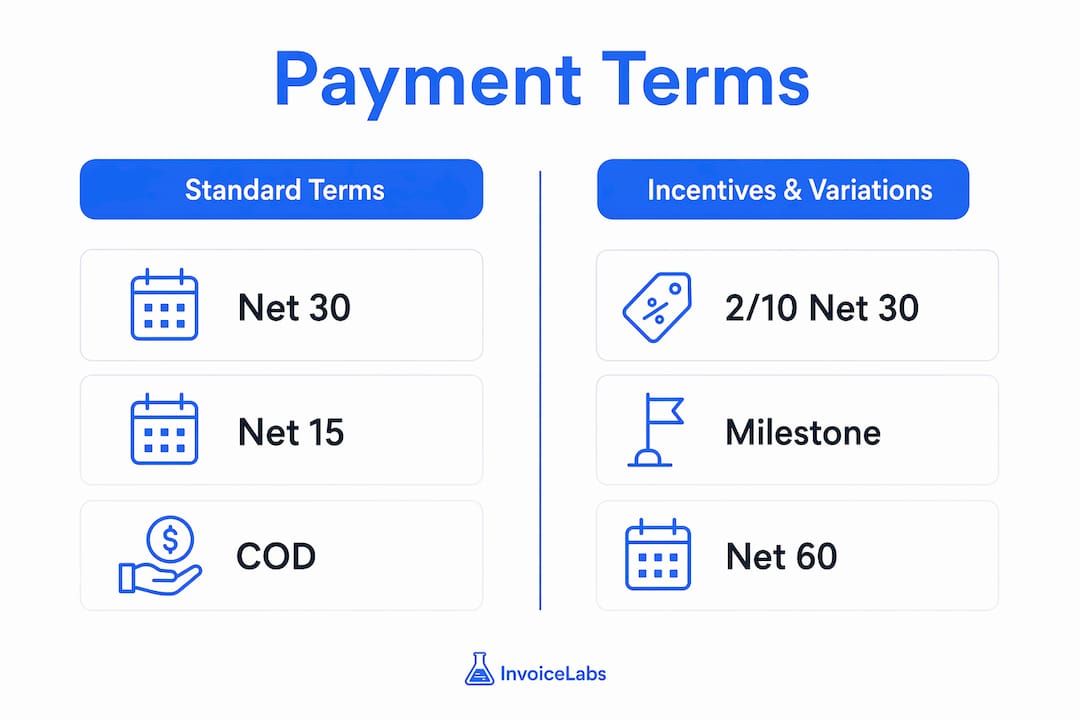
- Net 30: Payment is due within 30 calendar days of the invoice date. Example wording: “Payment due within 30 days of invoice date.” This is the US standard term for business-to-business transactions.
- Net 15: Payment is due within 15 days. Example wording: “Payment due within 15 days of invoice date.” Common for freelancers and service providers who need faster cash turnaround.
- Net 60 / Net 90: Extended terms for larger contracts or long production cycles. Example wording: “Payment due within 60 days of invoice date.”
- Due on Receipt: Payment is expected immediately upon receiving the invoice, typically within one or two business days. Example wording: “Payment due upon receipt.” Best for first-time clients or small one-off jobs.
- 2/10 Net 30: Full payment is due in 30 days, but the client gets a 2% early discount if they pay within 10 days. Example wording: “2% discount if paid within 10 days; net amount due within 30 days.”
- Cash in Advance (PIA): The buyer pays before work begins or goods ship. Example wording: “Full payment required before project start.” Contractors and custom manufacturers use this to protect against cancellations.
- Cash on Delivery (COD): Payment is made at the moment of handoff. Example wording: “Payment due at time of delivery.” Mostly applies to physical goods.
- End of Month (EOM): The full balance is due by the last day of the invoice month, regardless of the specific invoice date. Example wording: “Payment due by end of invoice month.”
- 15 MFI (Month Following Invoice): Payment is due on the 15th of the month after the invoice month. Example wording: “Payment due on the 15th of the month following invoice date.” An invoice dated april 20 means payment is due may 15.
- 50% Up Front, 50% on Delivery: Payment is split into two stages. Example wording: “50% deposit required to begin; remaining 50% due upon project delivery.” Standard for larger or complex projects.
Pro Tip: Always pair a term like “Net 30” with a specific calendar date on the invoice itself. Writing “Due by May 15, 2026” alongside “Net 30” removes any ambiguity about when the clock started, and accounts payable teams process those invoices faster.

Why payment terms directly affect your business cash flow
Clear payment terms are the single most controllable factor in how predictably cash moves through your business. When terms are vague or missing entirely, clients fill the gap with their own interpretation, and that interpretation almost always favors their cash position over yours.

The relationship between payment terms and cash flow is direct. A freelancer invoicing $5,000 on Net 30 terms waits a month to collect. The same invoice on Net 15 terms cuts that wait in half, freeing up capital for expenses, payroll, or the next project. For a small business managing cash flow, that difference compounds across every invoice you send.
Here is what poorly defined terms actually cost you:
- Delayed payments: Without a clear deadline, clients default to paying when it is convenient for them, not when it is due.
- Disputes at the last minute: A buyer can sit on an invoice for weeks, then raise a billing question right before the deadline, effectively resetting the clock.
- No legal recourse: Payment terms set in a contract are the legal foundation for collections. Terms that exist only on an invoice and were never agreed to in writing are harder to enforce.
- Cash flow gaps: Unpredictable payment timing makes it difficult to cover operating costs, hire help, or take on new work with confidence.
Well-stated terms protect both sides. The client knows exactly what is expected. You know exactly when to follow up.
How each major payment term works in US practice for 2026
Net 30 remains the standard for most US business-to-business invoicing in 2026, but it is far from the only option. The right term depends on your industry, your client relationship, and how much cash flow risk you can absorb.
| Term | Payment Due | Typical Use | Cash Flow Impact |
|---|---|---|---|
| Net 15 | 15 days from invoice date | Freelancers, small service jobs | Fast; minimal wait |
| Net 30 | 30 days from invoice date | Standard B2B across most industries | Moderate wait; widely accepted |
| Net 60 | 60 days from invoice date | Large contracts, manufacturing | Slower; requires cash reserves |
| Net 90 | 90 days from invoice date | Enterprise, construction | Slowest; significant float |
| 2/10 Net 30 | 30 days; 2% off if paid in 10 | Any B2B wanting faster payment | Accelerated when discount taken |
| Due on Receipt | Immediately (1–2 business days) | New clients, small one-off jobs | Fastest possible |
| COD | At time of delivery | Physical goods, high-risk buyers | No credit extended |
| EOM | Last day of invoice month | Recurring billing, subscriptions | Predictable monthly cycle |
| 15 MFI | 15th of following month | Wholesale, distribution | Standardized but delayed |
| PIA / Cash in Advance | Before work begins | Custom orders, high-value projects | Best protection for seller |
A few practical notes on how these terms actually play out:
- Net 30 vs. Net 60: The gap matters more than it looks. A vendor with $50,000 in monthly receivables on Net 60 instead of Net 30 is effectively floating $50,000 to their clients at no charge.
- COD is common for physical goods and high-risk buyers. “Cash” is a misnomer; card and check payments typically count.
- EOM standardizes recurring billing. An invoice sent on march 3 and one sent on march 28 both come due march 31, which simplifies bookkeeping for both parties.
- 2/10 Net 30 can yield roughly a 37% annualized return for the vendor when the discount is captured, which is why it remains a popular incentive despite the reduced invoice amount.
How to write effective payment terms on an invoice
The wording on your invoice either removes friction or creates it. Vague phrasing like “payment expected soon” is useless. Specific, plain-language terms get paid faster.
Use exact calendar dates alongside term abbreviations
“Net 30” is useful shorthand, but pairing it with a specific date like “Due by June 15, 2026” eliminates any dispute about when the 30 days started. Accounts payable staff processing dozens of invoices will not calculate backward from your invoice date. Give them the answer.
Example wording for common scenarios
- Standard Net 30: “Payment of $2,500.00 is due by June 15, 2026 (Net 30). Please remit via ACH to [routing/account number] or pay by card at [link].”
- Early payment discount: “2% discount ($50.00) applied if payment received by May 26, 2026. Full amount of $2,500.00 due by June 15, 2026.”
- Due on Receipt: “Payment of $800.00 is due upon receipt of this invoice. Accepted methods: Stripe, ACH, check.”
- Split payment: “$1,500.00 deposit due before project start. Remaining $1,500.00 due upon delivery.”
- Late fee notice: “A late fee of $35.00 applies to balances unpaid after the due date. Interest of 1.5% per month accrues on overdue balances.”
Best practices for placement and clarity
- Put payment terms directly next to or below the “Total Amount Due” line. When the client’s eye lands on the amount, the deadline should be right there.
- Bold the due date and the late fee amount. A light background or simple border around the payment block separates it from line-item detail.
- Keep the terms to three or four lines on the invoice itself: the due date, accepted payment methods, the late fee, and the early payment discount if you offer one. Anything more detailed belongs in your contract.
- Always specify the currency on international invoices. “All amounts in USD” prevents a client from paying the right number in the wrong currency.
Pro Tip: Check out the billing and invoicing guide from Invoicelabs for a deeper walkthrough on structuring your invoice layout for faster payment.
Tips for managing payment terms and getting paid on time
Writing good terms is half the job. Enforcing them consistently is the other half.
Negotiate terms before the work starts
The best time to discuss payment terms is before you send the first invoice, not after a payment is late. State your standard terms clearly in your proposal or contract. If a client pushes back, you have room to negotiate without the pressure of an overdue balance.
- Lead with your preferred terms: “Our standard terms are Net 15. Does that work for your accounts payable cycle?”
- For larger projects, offer staged payments rather than extending the net period: “We can do Net 30, but we’d need 25% up front to get started.”
- If a client requests Net 60 or Net 90, factor the extended wait into your pricing. Longer payment windows cost you real money.
Incentivize early payment
A 2/10 Net 30 discount gives clients a concrete financial reason to pay early. The 2% you give up is almost always worth the improved cash position. You can also offer a flat dollar discount for early payment on smaller invoices where percentages feel awkward.
Handle late payments without burning the relationship
Late fees of $25–$50 per occurrence and monthly interest of 1%–1.5% on overdue balances are standard in commercial invoicing. The key is stating these clearly on the invoice and in your contract before the work begins, not springing them on a client after the fact.
- Build in a short grace period of five to ten days before the late fee triggers. It preserves goodwill while still creating urgency.
- Send a payment reminder two to three days before the due date, not after. A friendly heads-up reduces late payments without any confrontation.
- For clients who are consistently late, shorten their terms on the next engagement or require a deposit up front.
Stay consistent across every invoice
Inconsistent terms confuse clients and undermine your ability to enforce them. Pick your standard terms, write them the same way every time, and make sure they match what is in your contract. One version of the truth across every document you send.
Reviewing your small business payment processing setup annually is worth the time, especially as payment methods and client expectations shift.
How Invoicelabs helps you manage payment terms efficiently
Getting the terms right on paper is one thing. Getting them onto every invoice, consistently and quickly, is where most freelancers and small business owners lose time.
Invoicelabs lets you create a complete, professional invoice in under 30 seconds, with payment terms, tax calculations, and discounts built in from the start. Here is what that looks like in practice:
- Real-time tax and discount calculations: Enter a 2/10 Net 30 discount and Invoicelabs calculates both the discounted and full amounts automatically. No manual math, no errors.
- Instant delivery and status tracking: Send the invoice the moment the work is done and see exactly when the client opens it. You know whether to follow up before the due date arrives.
- Stripe payment integration: Clients can pay by card directly from the invoice. Faster payment methods mean faster actual payment.
- Profession-specific templates: Whether you are a web developer, a graphic designer, a personal trainer, or a tutor, Invoicelabs has templates built around the payment terms and line items your industry actually uses.
- Brand customization: Add your logo, colors, and business details so every invoice looks like it came from a professional operation, not a generic form.
- Bank-grade security: Client payment data and invoice records are protected at the same security standard used by financial institutions.
- Multi-currency support: Invoice international clients in their currency without a separate conversion step.
For freelancers juggling multiple clients or agencies sending dozens of invoices a month, the time savings compound fast. Invoicelabs removes the friction between finishing the work and getting paid for it.
Are payment terms legally enforceable?
Payment terms are legally enforceable when they are clearly stated and agreed to in writing before the work begins. An invoice alone is not always enough. The strongest legal position comes from including all payment terms, including deadlines, late fees, interest rates, and dispute procedures, in a signed contract or service agreement.
Under the Uniform Commercial Code (UCC), which governs commercial transactions across most US states, payment terms in a written agreement are binding on both parties. The UCC also provides default rules when terms are missing or ambiguous, but those defaults may not favor your position. Specifying your terms explicitly in a contract removes that uncertainty entirely.
A few practical legal points worth knowing:
- Late fees and interest must be disclosed in advance. Charging a late fee that was never communicated to the client before the work began is difficult to enforce and can damage the relationship. State fees clearly in both the contract and on every invoice.
- Credit card surcharges are regulated. Several US states prohibit surcharges on credit card payments. Surcharges on debit card payments are not permitted under federal law. If you pass processing fees to clients, check your state’s rules first.
- Dispute windows protect you. Requiring clients to notify you of billing errors within 10–15 business days of the invoice date prevents a buyer from sitting on an invoice and raising a dispute right before the deadline.
- Currency must be specified for international invoices. Stating “All amounts in USD” on every invoice avoids reconciliation problems when clients pay in a different currency.
When a payment genuinely goes uncollected, the signed contract with clear payment terms is what a court examines, not the invoice. Build your terms there first, then reflect them on every invoice you send.
How payment terms differ across industries and regions
Payment terms are not one-size-fits-all. What is standard in professional services would be unusual in retail, and what works for a US-based freelancer may not align with expectations from a client in Europe or Asia.
Industry differences in the US
Professional services such as consulting, design, and marketing typically use Net 15 or Net 30. These clients expect a short credit window, and the work is usually delivered before payment is due.
Construction and large-scale project work operates differently. Milestone payments are common: a deposit before work starts, progress payments at defined stages, and a final payment on completion. Net 60 or Net 90 terms appear frequently in construction because project timelines are long and subcontractors have their own payment cycles to manage.
Retail and wholesale distribution often use COD or very short net terms for smaller buyers. Established wholesale relationships may use Net 30 or EOM terms, with COD reserved for new or high-risk accounts.
Healthcare and government contracting tend toward longer payment cycles, sometimes Net 60 or beyond, driven by internal approval processes rather than client preference.
Regional differences
US businesses generally expect Net 30 as the default. In the European Union, the Late Payment Directive sets a maximum of 60 days for business-to-business transactions, with 30 days as the default for public authorities. In the United Kingdom, the Prompt Payment Code encourages payment within 30 days, though larger companies often push suppliers toward 60 or 90 days in practice.
In parts of Asia and Latin America, longer payment windows of 60–90 days are more culturally accepted, particularly in manufacturing and export trade. The US International Trade Administration notes that cash in advance is the most secure payment method for exporters dealing with new or unknown international buyers, since it eliminates the risk of non-payment entirely.
If you work with international clients, build currency, payment method, and timeline expectations into your contract from the start. What feels like a standard Net 30 to you may read as aggressive to a buyer in a market where 60 days is the norm.
Key Takeaways
Clear, specific payment terms on every invoice are the most direct way to protect your cash flow and reduce late payments.
| Point | Details |
|---|---|
| Net 30 is the US standard | Net 30 remains the default for most US B2B invoicing, with Net 60/90 for larger contracts. |
| Pair terms with calendar dates | Writing “Due by June 15, 2026” alongside “Net 30” eliminates ambiguity and speeds up payment. |
| 2/10 Net 30 accelerates cash | A 2% discount for payment within 10 days can yield roughly a 37% annualized return for the vendor. |
| Late fees require advance disclosure | Flat fees of $25–$50 and monthly interest of 1%–1.5% are standard, but must be stated in the contract first. |
| Terms vary by industry and region | Professional services favor Net 15–30; construction uses milestone payments; international norms often run 60–90 days. |
Recommended
Send your next invoice in seconds
Create professional invoices, track payments and get paid faster — free to start.