Jewelry Invoice Template: Professional Guide for Jewelers
A jewelry invoice template is a specialized billing document designed to capture item-level detail, pricing breakdowns, and compliance data that standard invoices simply cannot accommodate. For jewelry business owners and freelancers, using the right invoice template for jewelers is not optional. It directly affects customer trust, legal standing, and how fast you get paid.
Jewelry invoices differ from standard service invoices in a critical way. They require industry-specific fields like Hallmarking Unique Identification (HUID), exact metal weight, and purity levels. These fields exist for legal and consumer trust purposes, not just record-keeping. A generic billing form leaves you exposed to disputes, audit risk, and a weaker brand impression.
What are the essential elements of a jewelry invoice template?
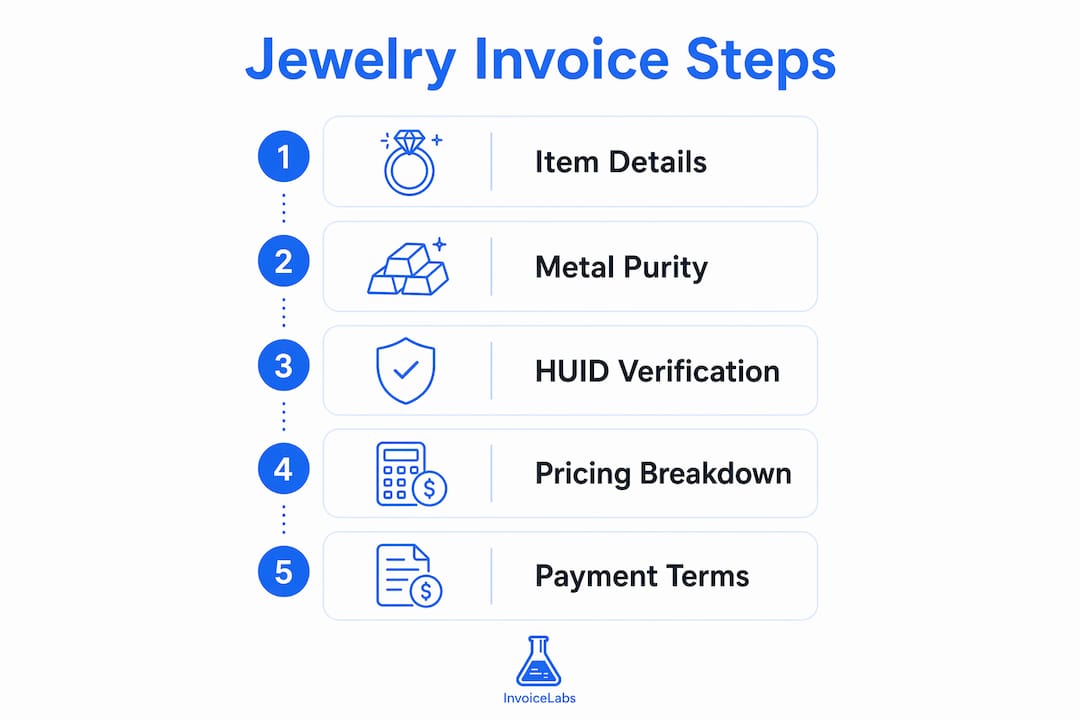
A professional jewelry invoice must contain 8 essential elements to meet both legal requirements and customer expectations. Skipping even one can create compliance gaps or erode buyer confidence.
The core fields every invoice template for jewelers needs:
- Business and seller information: Your full business name, address, phone number, email, and GST registration number (GSTIN).
- Customer information: Buyer’s name, contact details, and billing address.
- Unique invoice number: A sequential reference that supports audit trails and payment tracking.
- Invoice date and due date: Both are required for payment terms enforcement.
- Detailed item description: This is where jewelry invoices earn their complexity. Each line item must include the piece name, metal type, gross weight, net weight, gold purity (e.g., 22K or 18K), HUID, making charges, and wastage charges listed separately.
- Precious stone details: For pieces with diamonds or gemstones, include carat weight, cut, color, and clarity.
- Tax breakdown: GST applied at the correct rate, shown as a separate line.
- Total amount and payment terms: The final payable amount, accepted payment methods, and any deposit or installment structure.
Industry standards require HUID, exact gold weight, purity, and a clear separation of metal value versus making charges on every invoice. This separation matters because customers increasingly scrutinize what they pay for craftsmanship versus raw material. Mixing these figures together is one of the fastest ways to trigger a dispute.
Pro Tip: Always verify the HUID printed on the invoice matches the hallmark stamp on the physical piece before handing it to the customer. This single check eliminates the most common post-sale complaints.

Which digital formats work best for a jewelry invoice?
The format of your invoice affects how professional it looks, how easy it is to edit, and whether it can scale with your business. The three formats jewelry businesses use most are PDF, Word (DOCX), and API-generated templates.
PDF is the most widely used format for a printable jewelry invoice because it locks the layout and prevents accidental edits. Word documents offer more flexibility for jewelers who need to adjust fields frequently, such as freelancers handling custom orders with varying specifications. API-generated invoices represent the most advanced option. Automation reduces data entry time by up to 90% by generating invoices through a single API call, pulling item data directly from your catalog or order management system.
| Format | Ease of use | Branding control | Automation ready | Cost |
|---|---|---|---|---|
| PDF template | High | Medium | No | Free to low |
| Word (DOCX) | High | Medium | No | Free |
| API-generated | Medium | High | Yes | Varies |
| Digital platform | Very high | High | Yes | Subscription |
One detail most jewelers overlook: embedding logos as base64 in PDF invoices prevents logo loading failures during export. When a PDF is generated on a server without internet access, external image URLs break. A base64-encoded logo loads from within the file itself, so your brand appears correctly every time.
Pro Tip: If you use a billing system or CRM, check whether it supports invoice template integration via API or webhook. Connecting your order data directly to your invoice generator eliminates manual entry and the errors that come with it.
How can jewelers customize invoice templates for different sales?
A one-size-fits-all layout does not work for jewelry businesses that handle retail sales, custom commissions, bulk wholesale orders, and repair jobs simultaneously. The right billing approach for freelancers and small studios starts with a flexible base template that adapts to each transaction type.
Visual brand elements come first. Your logo, font choices, and color palette should appear consistently across every document you send. Customers who receive a polished, branded invoice perceive higher value in the product they just purchased. This is especially true for custom jewelry, where the buying experience extends well beyond the handoff.
Key customization areas to address:
- Payment terms and methods: Clearly state net payment periods (e.g., Net 7 or Net 30), accepted methods (bank transfer, credit card, Stripe), and any late payment fees.
- Deposit and progress billing fields: Custom orders often require deposits and staged payments. Your template needs dedicated fields for deposit amount, balance due, and milestone descriptions.
- Repair and alteration invoices: These need fields for the original piece description, work performed, parts replaced, and turnaround time.
- Bulk and wholesale orders: Add fields for quantity discounts, unit pricing, and purchase order references.
- Freelancer-specific adjustments: Independent jewelry designers often work without a storefront. Their invoices benefit from a clean, minimal layout with a strong logo and clear payment link, since the invoice itself represents the brand.
A retail jeweler’s invoice looks different from a freelance jewelry designer’s invoice, and both look different from a wholesale supplier’s document. Building separate template variants for each scenario saves time and prevents the awkward experience of sending a retail-style invoice to a wholesale buyer.
What mistakes should jewelers avoid with invoice templates?
The most damaging invoicing mistakes are not typos. They are structural omissions that create legal exposure or destroy customer confidence at the moment of sale.
- Omitting GST or registration numbers. Missing seller registration or GST details can trigger penalties during tax audits. Every invoice must display your GSTIN clearly, regardless of transaction size.
- Leaving out metal purity or HUID. A jewelry sales receipt without hallmark details gives customers no way to verify what they bought. This is the leading cause of post-sale disputes in the gold jewelry market.
- Bundling making charges into the total. Lack of transparency on making charges versus gold value increases purchase disputes and damages trust. Always list them as separate line items.
- Missing payment references. An invoice without a payment reference number, bank account details, or a payment link forces the customer to contact you before they can pay. Every delay costs you time and cash flow.
- No signature or authorization field. For high-value custom pieces, a seller signature or digital authorization adds a layer of legal protection for both parties.
Performing an invoice quality check before sending, verifying hallmark details, GSTIN presence, and payment references, reduces compliance risk and improves customer satisfaction. Build this check into your workflow as a standard step, not an afterthought.
Pro Tip: Store digital copies of every invoice in a cloud-based system with automatic backups. Tax authorities in most jurisdictions require invoice records for a minimum of 5–7 years. A local hard drive is not a compliance strategy.
Key Takeaways
A well-built jewelry invoice template protects your business legally, builds customer trust, and gets you paid faster by removing ambiguity from every transaction.
| Point | Details |
|---|---|
| Include HUID and metal purity | Every jewelry invoice must list HUID, gold purity, and net weight to meet legal standards. |
| Separate making charges | List making charges and metal value as distinct line items to prevent disputes. |
| Match format to your workflow | Use PDF for simplicity, API-generated templates for volume, and digital platforms for automation. |
| Customize per sale type | Build separate template variants for retail, custom orders, repairs, and wholesale. |
| Perform a quality check | Verify GSTIN, hallmark details, and payment references before sending every invoice. |
Why I think most jewelers underinvest in their invoice design
Working closely with small business owners across creative industries, the pattern is consistent: the invoice is the last thing anyone thinks about and the first thing that causes a problem. Jewelry businesses are especially vulnerable because their invoices carry legal weight that a freelance graphic designer’s invoice simply does not.
The uncomfortable truth is that a poorly designed jewelry invoice signals to a customer that the business behind it is not fully professional. When someone spends $2,000 on a custom ring, the invoice they receive shapes how they remember the entire experience. A cluttered, incomplete document creates doubt. A clean, detailed, branded invoice reinforces the quality of the piece itself.
The businesses I have seen grow fastest are the ones that treat their invoice as a client-facing document, not an internal accounting form. They update their templates as their product lines expand. They add payment links so customers can pay in one click. They include a thank-you line at the bottom because it costs nothing and builds loyalty.
The technology to do all of this exists and is accessible to a solo jeweler working from a studio. The only barrier is deciding to prioritize it. Start with a solid base template, add your compliance fields, embed your logo properly, and build from there. Your invoice is often the last document a customer sees before they walk out the door. Make it count.
— Black Flame Digital
Invoicelabs makes professional jewelry invoicing simple
Jewelry business owners who want professional, compliant invoices without spending hours on formatting can use the free invoice generator from Invoicelabs to create a complete invoice in under 30 seconds. The platform handles real-time tax calculations, instant delivery, and invoice status tracking so you always know when a payment is on its way.
Invoicelabs supports brand consistency across all your documents, with logo embedding and customizable layouts that work for retail sales, custom commissions, and repair jobs alike. Payment collection through Stripe is built in, so clients can pay the moment they receive the invoice. With bank-grade security and no hidden fees, Invoicelabs gives jewelry professionals a billing tool that matches the quality of the work they sell. Visit Invoicelabs to get started.
FAQ
What is a jewelry invoice template?
A jewelry invoice template is a pre-formatted billing document that includes fields specific to jewelry sales, such as HUID, metal purity, gross and net weight, making charges, and GST breakdown. It differs from a standard invoice by meeting both legal compliance requirements and the detailed transparency customers expect.
What fields are required on a jewelry invoice?
A compliant jewelry invoice must include the seller’s GSTIN, the buyer’s details, a unique invoice number, item descriptions with HUID and gold purity, a separate breakdown of making charges, applicable GST, and the total amount due. Missing any of these fields creates audit risk and potential customer disputes.
Can I use a digital jewelry invoice instead of a printed one?
Yes. A digital jewelry invoice sent as a PDF or generated through an invoicing platform carries the same legal weight as a printed document in most jurisdictions. Digital formats also support faster delivery, payment links, and automated record-keeping.
How do I handle invoices for custom jewelry orders?
Custom jewelry invoices should include a deposit field, a balance-due field, and a milestone or progress billing section. This structure gives both the jeweler and the client a clear record of what has been paid and what remains outstanding at each stage of the commission.
Why should I separate making charges on a jewelry invoice?
Separating making charges from the metal value on a jewelry invoice prevents the most common source of purchase disputes. Customers have a right to see exactly what they are paying for craftsmanship versus raw material, and this transparency builds the trust that drives repeat business.
Recommended
Send your next invoice in seconds
Create professional invoices, track payments and get paid faster — free to start.