VAT Number on an Invoice in the UK: Where It Goes and What Else to Show
VAT Number on an Invoice in the UK: Where It Goes and What Else to Show

If you are VAT-registered in the UK, your nine-digit VAT registration number must appear on every invoice you raise, next to your business name and address, with the VAT shown separately from the net price. If you are not registered, you have no number and you cannot charge VAT. That is the whole rule. The rest of this guide covers where the number sits, what else a VAT invoice needs, how to check a number someone has given you, and the mistakes that cause trouble later.
TL;DR
- A VAT-registered business must quote its 9-digit VAT number on all invoices, and cannot charge VAT until the number has been issued.
- Put it with your supplier details at the top of the invoice, and show VAT as its own line, not buried in the price.
- The VAT number is not the invoice number. The invoice number is a unique sequential reference you create yourself.
- You can verify a customer’s or supplier’s number on GOV.UK’s VAT number checker, which shows the registered name and address.
- Get the template right once, save it, and every later invoice carries the number and the correct VAT automatically.
Table of Contents
- When you must put a VAT number on an invoice
- What a UK VAT registration number looks like
- Where to put the VAT number on the invoice
- What else a VAT invoice must show
- The VAT number is not the invoice number
- How to check a VAT number you have been given
- Common mistakes with VAT numbers on invoices
- Setting up your invoices so the number is never missed
- Try it on your next invoice
- Our view: get the details right once
- FAQ
- Sources
When you must put a VAT number on an invoice
The trigger is registration, not the size of the invoice. GOV.UK’s guidance on charging VAT says that when you sell goods or services as a VAT-registered business, your invoices must include your VAT number and show the VAT separately. Zero-rated sales still have to be accounted for and shown on the invoice at 0%.
The flip side matters just as much. GOV.UK’s page on how to register for VAT says you cannot include VAT on your invoices until you have your number. If you are waiting for confirmation, you may raise your prices to cover the VAT you will owe, but you cannot show a VAT line or invent a number.
Are you required to be registered?
Most freelancers and small firms meet this question as their income grows. According to GOV.UK’s guidance on when to register, you must register if your taxable turnover over the last 12 months goes above £90,000 (the VAT threshold), or if you expect it to go over that figure in the next 30 days. You can also register voluntarily below the threshold. Because the threshold is set by the government and can change, check that page for the current figure before you rely on it.
Two practical points follow from this:
- Registration is a decision about turnover and tax, not about invoicing. Talk to an accountant or HMRC if you are close to the threshold or unsure which of your sales count as taxable.
- Once you are registered, the invoicing rules below apply from your effective date of registration.
What a UK VAT registration number looks like
HMRC’s registration manual explains that a registered trader receives a unique nine-digit VAT registration number, which they quote on invoices for taxable supplies. The number stays with you until the registration is cancelled, or until a business is transferred as a going concern and the new owner chooses to keep it.
In everyday use you will usually see the nine digits written with a GB prefix, for example GB 123 456 789 (a made-up number for illustration). Use the format printed on your HMRC registration certificate, and stay consistent across all invoices.
Northern Ireland has one extra rule. Under regulation 14(2) of the VAT Regulations 1995, a business identified for VAT in Northern Ireland that invoices a customer in an EU member state must put the letters XI before its registration number on the invoice.

Where to put the VAT number on the invoice
The rules require the number to appear on the invoice. They do not dictate a position on the page. The convention that readers and accounts departments expect is to place it with your supplier details, in the header block:
- Your business name and address.
- Your VAT registration number, labelled clearly (“VAT number” or “VAT reg no.”).
- Your contact details, and company number if you are a limited company.
Keep it visible, not in a footer in pale grey type. Your customer’s bookkeeper will look for it in order to reclaim VAT, and an invoice they cannot read easily is an invoice that gets queried.
A worked example
Say you are a VAT-registered designer billing a client for a brand identity project.
| Line | Amount |
|---|---|
| Brand identity design, 1 project | £1,500.00 |
| VAT at 20% | £300.00 |
| Total due | £1,800.00 |
The header carries your name, address and VAT number. The invoice number (say, 1042) is separate. The VAT rate and the VAT amount in pounds sterling are each visible. If one line were zero-rated, it would appear at 0% on its own line rather than being left out.
What else a VAT invoice must show
The VAT number is one item on a list. HMRC’s VAT invoice manual (VATREC5010), which draws on regulation 14(1) of the VAT Regulations 1995, sets out that a full VAT invoice includes:
- a unique, sequential invoice number
- the time of supply (the tax point) and the date of issue
- your name, address and VAT registration number
- your customer’s name and address
- a description of the goods or services
- the quantity and the VAT rate for each item, and the unit price
- the total excluding VAT, and any cash discount offered
- the total VAT chargeable, in pounds sterling
- a reference to a margin scheme or reverse charge where one applies
GOV.UK’s invoicing guidance adds that you must use a VAT invoice when both you and your customer are VAT-registered, and that these carry more detail than a non-VAT invoice. HMRC’s compliance guidance confirms a VAT invoice can be on paper or in electronic form, so a PDF sent by email counts.
We go through each field in more detail in our guide to the mandatory fields on a UK VAT invoice.
The date that catches people out
The time of supply and the date of issue are two different things. The time of supply (often called the tax point) is when VAT becomes due, and the issue date is when you actually produce the invoice. Both should be on the page. If you are unsure how a deposit or a pro forma affects the tax point, our guide to converting a pro forma into a compliant VAT invoice walks through it.
The VAT number is not the invoice number
This is a common confusion, and it is one of the questions people ask most. Your VAT number identifies your business to HMRC and never changes from one invoice to the next. The invoice number identifies one document and changes every time.
HMRC’s manual says invoice numbers can be numbers or a mix of letters and numbers, as long as they form a unique sequential series. The series may start at any number, for example 1135, provided it then runs consecutively. Running more than one sequence at the same time, say one per branch or per brand, is acceptable.
In practice:
- Do not reuse a number, even for a cancelled invoice. Issue a credit note and keep the sequence intact.
- Do not start every invoice with your VAT number as a shortcut for numbering. It is not unique per document.
- Keep a copy of every invoice you issue, since the invoice is a statutory record.
How to check a VAT number you have been given
If a supplier or customer quotes a VAT number, you can confirm it. GOV.UK’s Check a UK VAT number service tells you whether a number is valid and shows the name and address it is registered to. You cannot search by business name, so you need the number itself. Most businesses publish it on their invoices, receipts or website.
Why bother?
- As a supplier, you want to be sure the customer you are invoicing is who they say they are, particularly for a large first order.
- As a customer, HMRC’s compliance guidance treats the purchase invoice as the evidence for reclaiming input VAT. If the supplier’s number on that invoice is wrong, your claim rests on a weak document.
A VAT-registered business can also use its own number on the service to get proof of when it made a check, which is useful for your records.
Common mistakes with VAT numbers on invoices
Showing a number before you have one. You cannot charge VAT until HMRC has issued your registration number. An invoice with a made-up or placeholder number is a problem for you and your customer.
Leaving the number off a letterhead invoice. Plain documents printed on company stationery often lack the number. If your template is a word-processor file you reuse, check it has the number in the header.
Typing it differently each time. A transposed digit means your customer cannot validate it and may hold up payment while they query it.
Hiding VAT in the price. The VAT must be shown separately, as a rate and an amount in sterling.
Forgetting zero-rated lines. They still need to appear, at 0%.
Mixing up a VAT invoice with a receipt or pro forma. A pro forma is a request for payment ahead of supply, not a VAT invoice. Our guides on pro forma versus invoice and invoice versus receipt explain where each fits.

Setting up your invoices so the number is never missed
The most reliable way to get the VAT number on every invoice is to stop retyping it. Build the invoice from a template where your business details, VAT number, logo and layout are fixed once, and only the client, lines and dates change. Then check four things before sending:
- Your VAT number is in the header and matches your HMRC certificate.
- The invoice number follows on from the last one.
- Each line shows its VAT rate, and the VAT total is in pounds.
- The tax point and issue date are both present.
This is where a purpose-built tool earns its keep. With InvoiceLabs you can create an invoice in under 30 seconds, with tax and discounts calculated in real time as you add lines, so the totals you send are the totals you meant. Your logo and colours are applied across your documents, and the finished invoice downloads as a PDF. For the wider picture on formats, see our note on PDF versus e-invoice for UK freelancers and small businesses.
Try it on your next invoice
If you want to see how a clean, branded invoice looks before committing to anything, the free invoice generator lets you create one without opening an account. InvoiceLabs also has a free plan at £0 per month, and paid plans for when you need more clients and companies: Starter at £9 per month, Professional at £19 per month and Business at £49 per month, with unlimited invoices on the paid plans. Card payments taken on invoices through Stripe carry a 1% fee. You can see the full details on the InvoiceLabs plans page.
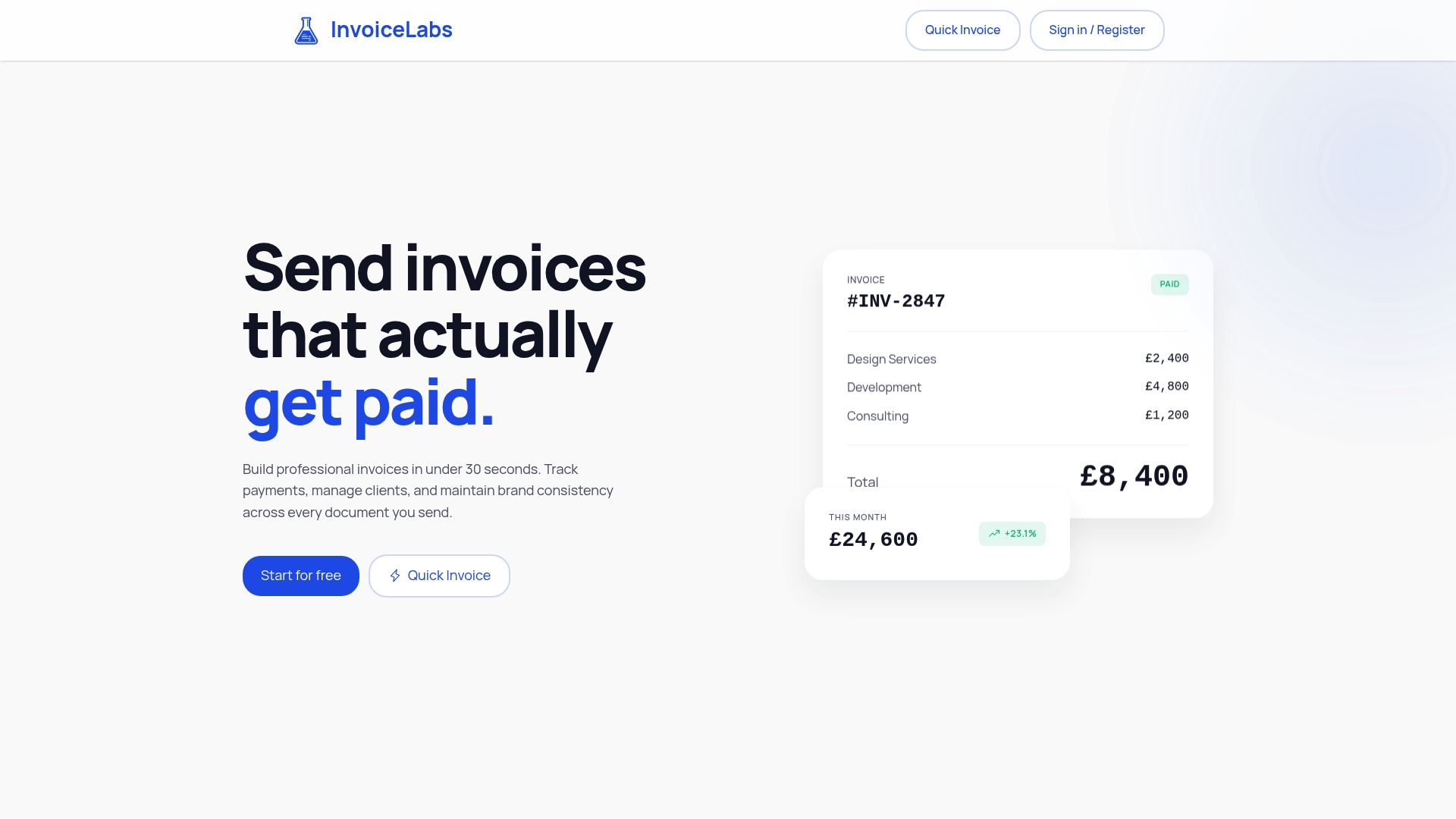
Invoices also show their status as they are sent and viewed, so you can see which ones are waiting and chase them sooner. That matters for cash flow: a correct VAT invoice that arrives instantly gets into your customer’s payment run earlier than one that has to be corrected and resent.
Our view: get the details right once
Most invoice queries we hear about are not about tax law. They are about small slips: a missing number, a total that does not add up, a logo that makes the document look unfinished. Each one gives a customer a reason to pause before paying.
We built InvoiceLabs around the idea that an invoice should take seconds and look like it came from a serious business. Real-time tax calculation means the VAT line follows the figures you enter. Instant delivery and live status tracking mean you know where an invoice stands. Branding control means your documents look the same every time, which is what clients associate with a business that is organised.
For a freelancer, a consultant or an agency, the best habit is to treat your VAT details as part of your brand. Set them up once in a template, then spend your time on the work rather than on retyping a number.
Black Flame Digital
FAQ
Do I need a VAT number on every invoice?
If you are VAT-registered, yes. GOV.UK says your nine-digit VAT number must be on all the invoices you raise, with the VAT shown separately. If you are not registered, you have no number and you do not charge VAT.
Can I put a VAT number on an invoice while my registration is pending?
No. You cannot include VAT on your invoices until HMRC has given you your number. GOV.UK notes you can raise your prices to cover the VAT you will owe, then issue VAT invoices once the number arrives.
How do I check whether a customer’s VAT number is real?
Use GOV.UK’s Check a UK VAT number service. Enter the number and it tells you whether it is valid, and the name and address it is registered to. You cannot search by company name, so ask the customer for the number first, or look on their previous invoices or website.
Is a VAT number the same as an invoice number?
No. The VAT number identifies your business and stays the same. The invoice number identifies a single invoice and must be unique and part of a sequential series, which can start at any number and mix letters and digits.
At what point do I need to register for VAT?
When your taxable turnover for the last 12 months goes over the VAT threshold, or you expect it to in the next 30 days. The threshold was £90,000 on GOV.UK’s page when this was written, so check the page for the current figure.
Sources
- Register for VAT: how to register, GOV.UK
- Register for VAT: when to register, GOV.UK
- Charge, reclaim and record VAT, GOV.UK
- VATREG03700, VAT Registration Manual, HMRC
- VATREC5010, VAT Traders’ Records Manual, HMRC
- Invoicing and taking payment from customers, GOV.UK
- COG941020, Compliance Operational Guidance, HMRC
- The Value Added Tax Regulations 1995, regulation 14
- Check a UK VAT number, GOV.UK
Recommended
Send your next invoice in seconds
Create professional invoices, track payments and get paid faster — free to start.


